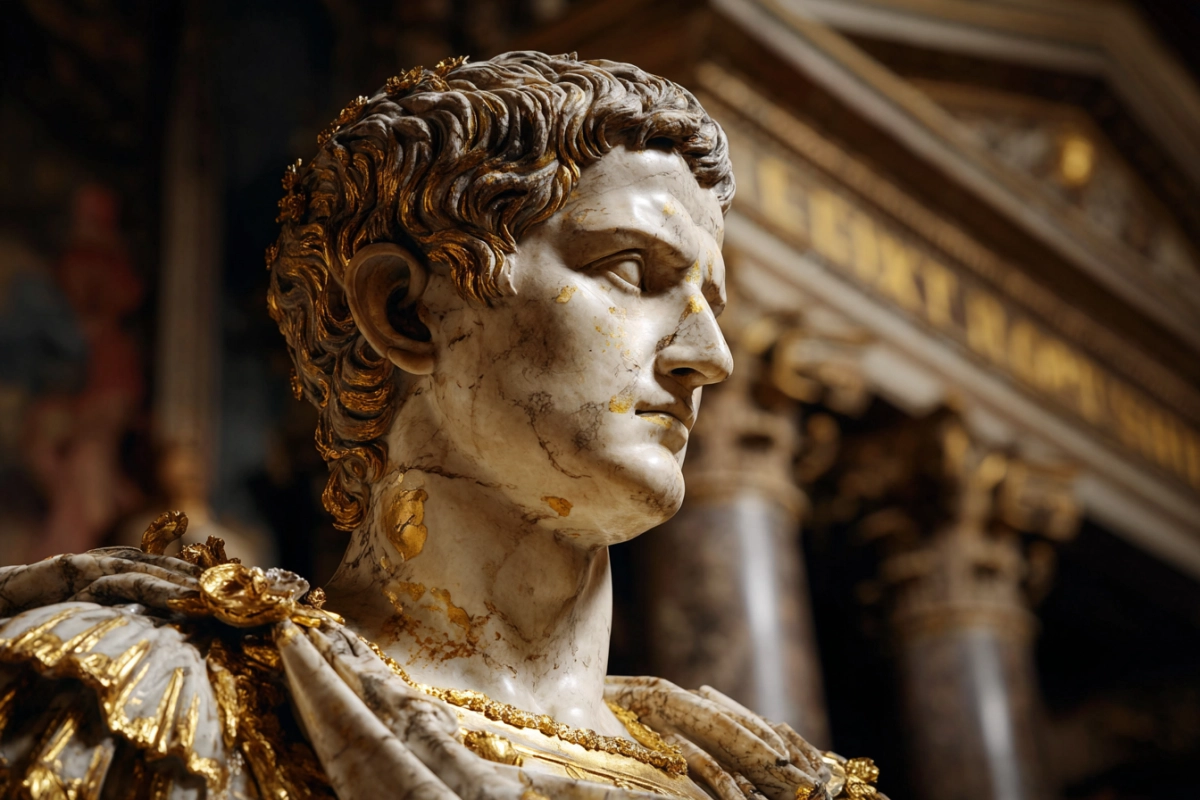
Julius Caesar: Life, Wars & Death
A soldier-statesman who conquered Gaul, crossed the Rubicon, and turned a republic’s crisis into a new age.
Introduction
A republic can survive bad leaders. It struggles to survive a system that rewards permanent emergency. Julius Caesar rose during the Roman Republic’s age of civil unrest—when generals commanded personal armies, elections became battlegrounds, and politics often ended with the sword. In a career that combined daring, calculation, and theatrical charm, Caesar turned victory into authority and authority into destiny.
This Julius Caesar biography follows the arc that made him famous and fatal: the wars that carved new provinces from Gaul, the fateful decision to cross the Rubicon, the collapse into Roman civil war, the reforms that tried to stabilize a shaking state, and the assassination of Julius Caesar on the Ides of March. The story ends where Rome’s next story begins—because Caesar’s death did not restore the republic. It accelerated its end.
For readers exploring Rome’s wider world, Caesar’s lifetime sits upstream of later imperial spectacle like the Roman Colosseum, and downstream of the frontier pressures and provincial revolts that define Rome’s longer story.
Fast Facts: Caesar at a Glance
-
He wrote his own war narrative.
Caesar’s commentaries shaped how Rome understood the Gallic Wars—part history, part political messaging.
-
His power was both legal and exceptional.
Roman dictatorship was an emergency office; Caesar’s repeated appointments stretched the category until it broke.
-
His reforms outlived the man.
The calendar change and administrative adjustments influenced Roman governance long after the Republic fell.
-
His death didn’t end Caesarism—it branded it.
Assassination turned Caesar into a political symbol used by successors, especially Augustus.
Origins: A Patrician Name in a Violent Republic
Caesar was born into the ancient Julii, a patrician family that claimed mythic descent from Venus—useful symbolism in a culture where ancestry was politics. Yet prestige did not guarantee safety. Rome in the early 1st century BCE was scarred by factional violence: street gangs, political assassinations, and the memory of proscriptions. Caesar’s early life was shaped by this atmosphere of coercion and improvisation.
As a young man, he learned that survival required alliances, public performance, and careful timing. He cultivated a reputation for courage and endurance—qualities that later served him as a commander. Equally important, he studied the Republic’s machinery: law courts, popular assemblies, and the Senate of Rome, where procedure could hide power and delay could kill.
Theme of the life: Caesar did not invent Rome’s crisis—he mastered it.
The Climb: Offices, Debts, and the First Triumvirate
Caesar’s rise blended ambition with calculated risk. He pursued public office, sponsored games, built networks, and acquired enemies. Like many Roman politicians, he carried heavy debts—but debt could be an investment if it bought visibility and votes.
The First Triumvirate
In 60 BCE, Caesar allied with two of the most powerful men in Rome: Pompey the Great, Rome’s celebrated general, and Marcus Licinius Crassus, its richest political operator. The First Triumvirate was not a formal constitution—it was a deal: resources, soldiers, and influence traded to push through careers and legislation that the Senate would otherwise block.
| Power Center | What Caesar Needed | What Caesar Offered | Why It Mattered |
|---|---|---|---|
| Pompey | Legitimacy, veteran support | Political cover for Pompey’s settlements | Aligned Caesar with a military titan—until rivalry returned. |
| Crassus | Financing and networks | Policy leverage and future opportunities | Money underwrote campaigns and public image. |
| Popular assemblies | Votes and street-level momentum | Reform rhetoric, patronage, spectacle | Helped Caesar build a base beyond the Senate. |
The Gallic Wars: Conquest, Reputation, and a Personal Army
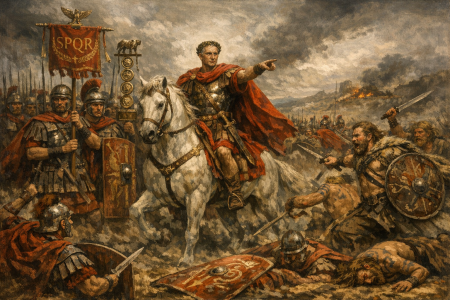
What Wars Did Julius Caesar Fight?
Caesar fought many campaigns, but two define his historical footprint: the Gallic Wars and the ensuing civil war. From 58 to 50 BCE, he led Roman armies across Gaul in a series of brutal, fast-moving conflicts that expanded Rome’s territory and multiplied Caesar’s fame. He fought rivals, managed shifting alliances, and faced coordinated resistance under Vercingetorix, culminating in the siege warfare that became a centerpiece of Roman military memory.
Why Gaul Changed Everything
- Wealth: plunder and new revenues rewarded troops and paid political costs.
- Prestige: victories made Caesar a household name in Rome.
- Loyalty: veterans came to see Caesar as their patron as much as their commander.
- Fear: the Senate saw a general returning with an army—Rome’s recurring nightmare.
By the late 50s BCE, Caesar had become more than an officeholder. He was a force—and the Republic had no stable method to absorb forces like him without violence.
Crossing the Rubicon: When Politics Became War
Why Did Julius Caesar Cross the Rubicon?
The Rubicon was a small river with a massive meaning: it marked the boundary where a governor could not legally bring troops into Italy. In 49 BCE, facing political isolation and the threat of prosecution, Caesar chose escalation. To cross the Rubicon was to declare that the dispute would not be settled by speeches or votes. It would be settled by legions.
Rome fractured into camps. Caesar moved rapidly, seizing key positions and forcing Pompey and many senators to flee. The conflict that followed—Caesar’s civil war (49–45 BCE)—was not a single battle but a chain of campaigns across Italy, Greece, Egypt, North Africa, and Spain.
Pharsalus: The Decisive Battle (48 BCE)
At Pharsalus in 48 BCE, Caesar faced Pompey’s larger forces. Against odds, Caesar’s veterans won a crushing victory. Pompey fled and was later killed in Egypt—an event that removed Caesar’s chief rival but did not end the Republic’s crisis.
| Year (BCE) | Event | Why It Matters |
|---|---|---|
| 49 | Caesar crosses the Rubicon | Breaks the legal boundary between civil and military power. |
| 48 | Battle of Pharsalus | Pompey defeated; Caesar becomes Rome’s dominant war leader. |
| 47–45 | Campaigns in Egypt, Africa, Spain | Caesar eliminates remaining opposition; civil war winds down. |
| 44 | Ides of March assassination | Violence returns to the Senate itself—and triggers new wars. |
Caesar’s wars reshaped Rome’s future power in ways later emperors would inherit—and sometimes distort. For a later portrait of absolutism under strain, compare Caligula.
Cleopatra, Spectacle, and the Politics of Image
In Egypt, Caesar became entangled with Cleopatra VII in a relationship that was personal and political. He backed her claim to power and spent time in Alexandria during a volatile struggle. Back in Rome, Cleopatra’s presence—and rumors about Caesar’s ambitions—fed anxieties among senators who feared monarchy returning under a new name.
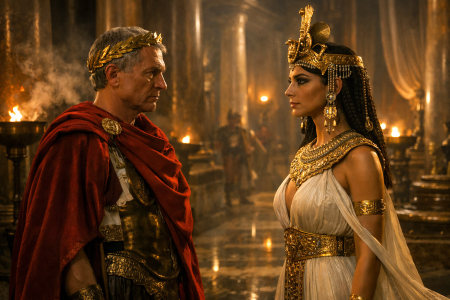
Caesar understood optics. He staged triumphs, sponsored public works, and presented himself as the Republic’s necessary fixer. The problem was not only what he did, but what his dominance implied: if one man could win the state by force, then the Republic had already lost its core bargain.
Reforms of Julius Caesar: Fixing a Republic in Freefall
What Did Julius Caesar Do for Rome?
Caesar’s reforms targeted immediate pressures—debt, administration, provincial governance, and political gridlock. Some measures were pragmatic attempts to restore functionality; others consolidated authority. Supporters saw a statesman stabilizing chaos. Critics saw a ruler making his position permanent.
-
Julian calendar:
Caesar reformed the Roman calendar (46 BCE), replacing drift and manipulation with a more stable solar system that took effect in 45 BCE—a legacy still felt in modern timekeeping.
-
Debt and finance:
He implemented policies to limit predatory practices and manage the debt crisis without simply erasing obligations—balancing elite interests with popular pressure.
-
Provincial administration:
Reforms aimed to curb extortion and improve oversight in provinces—areas where corruption often funded political careers in Rome.
-
Citizenship and colonies:
Caesar supported colonization for veterans and extended rights in ways that bound new communities to Rome, strengthening long-term loyalty.
-
Senate expansion:
He increased the Senate’s size and elevated new men, which broadened representation but also diluted the old aristocracy’s control.
-
Veterans, land, and colonies:
Caesar settled veterans and expanded colonies to relieve urban pressure, reward loyalty, and strengthen Rome’s hold on key regions—tying military service to social mobility and long-term political stability.
These reforms carried a paradox: the more Caesar solved problems by personal authority, the more the Republic’s traditional safeguards looked obsolete. Rome was learning to govern like an empire before it formally became one.
The Ides of March: Assassination in the Senate
Why Was Julius Caesar Assassinated?
In 44 BCE, Caesar accepted honors that looked increasingly monarchic to Rome’s political class. He was named dictator perpetuo (dictator for life), and rumors spread that kingship was returning—the very institution the Republic claimed to have abolished centuries earlier. For conspirators, the fear was existential: if Caesar lived, the Senate would become ornamental.
On 15 March 44 BCE—the Ides of March—Caesar entered a Senate meeting at the Theatre of Pompey. A group of senators led by Brutus and Cassius attacked him with concealed blades. Ancient accounts report dozens of blows; the image that endured is brutally intimate: a political argument ended at arm’s length.
How Did Julius Caesar Die?
Caesar died from stab wounds inflicted in the assault. The assassination was meant to restore liberty. Instead, it shattered the last illusions of compromise. Rome did not return to old rules; it plunged into further civil wars that elevated Caesar’s heir, Octavian (Augustus), and remade the Republic into the Roman Empire.
The assassination reads like a thriller, but its consequences were structural. The Republic’s collapse did not begin on the Ides of March—it became unavoidable when civil war made personal armies the final court of appeal.
Timeline: Julius Caesar’s Life in Key Events
- 100 BCE (traditional): Birth of Julius Caesar (date disputed)
- 60 BCE: First Triumvirate with Pompey and Crassus
- 58–50 BCE: Gallic Wars expand Roman power
- 49 BCE: Caesar cross the Rubicon; civil war begins
- 48 BCE: Pharsalus; Pompey defeated
- 46 BCE: Calendar reform and consolidation of authority in Rome
- 45 BCE: Julian calendar takes effect; civil war nears conclusion
- 44 BCE: Ides of March assassination
- 31–27 BCE: Aftermath culminates in Augustus and a new imperial order
Conclusion: Caesar’s Legacy and Rome’s Point of No Return
Caesar’s life reads like a sequence of decisive moments: Gaul, the Rubicon, Pharsalus, reforms, and the Ides of March. Yet the deeper story is the Republic’s transformation under pressure. Caesar proved that the old rules could be outpaced by speed, money, and soldiers—and once that lesson was learned, it could not be unlearned.
His assassination created a martyr for some and a warning for others, but it did not restore balance. The civil wars that followed ended with a new settlement: an emperor in all but name, then in name as well. In that sense, Caesar’s greatest legacy was not only what he conquered, but what he made inevitable—Rome’s transition from republic to empire.
Julius Caesar — Frequently Asked Questions
Why did Julius Caesar cross the Rubicon?
Because returning to Rome without an army risked political destruction and prosecution. Crossing the boundary in 49 BCE forced the dispute into open war—a bid to protect status, allies, and survival.
What were Julius Caesar’s most important wars?
The Gallic Wars (58–50 BCE) built his reputation and army; the Roman civil war (49–45 BCE) made him Rome’s dominant power.
How did Julius Caesar die?
He was stabbed to death during a Senate meeting on 15 March 44 BCE—the Ides of March—in an attack organized by a group of senators.
Why was Julius Caesar assassinated?
Conspirators feared Caesar’s power had become permanent and monarchical in practice. They claimed to defend the Republic and the Senate’s authority, but the killing triggered further civil wars instead.
What did Julius Caesar do for Rome?
He pursued administrative and social reforms, veteran settlements, provincial oversight, and the Julian calendar. Supporters saw stabilization; critics saw consolidation of one-man rule.
Did Caesar really create the Roman Empire?
Not directly. Caesar’s wars and dictatorship destabilized the Republic, but the imperial system emerged from the conflicts after his death—especially under Augustus.
Sources & References
- Adrian Goldsworthy, Caesar: Life of a Colossus (Yale University Press, 2006).
- Mary Beard, SPQR: A History of Ancient Rome (Liveright, 2015).
- Christian Meier, Caesar (Basic Books, 1996).
- Suetonius, The Twelve Caesars (primary source; various editions).
- Plutarch, Lives (primary source; various editions).
- Encyclopaedia Britannica, entries on Julius Caesar, the Ides of March, the Gallic Wars, and Pharsalus.
- Met Museum Heilbrunn Timeline of Art History — Roman Republic / Early Empire overviews.
- History.com, background explainers on the Julian calendar and the Ides of March.
More Articles