The Telephone: Invention and Global Impact
From early experiments to worldwide networks — how the human voice conquered distance.
Introduction
For most of human history, distance ruled communication. Messages moved at the pace of horses, ships, and human endurance. The telegraph changed that by sending coded pulses through wires, but it still demanded translation and training. The invention of the telephone did something stranger — and far more intimate. It carried the human voice itself, turning breath and vibration into electricity and then back again, as if distance had been edited out of reality.
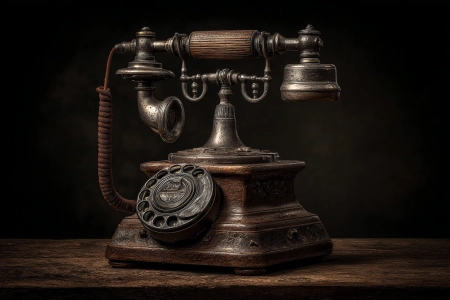
The telephone’s origins are both a breakthrough story and a rivalry story: laboratories crowded with coils, magnets, and tuning forks; entrepreneurs looking for the next network; and inventors racing to define what counts as “first.” This article follows the telephone invention through its key milestones — from early experiments and the Bell vs Gray patent controversy to the rise of exchanges, long-distance lines, and global communication. Along the way, it shows why the telephone was not just a device, but a new social system: a technology that reshaped business, family life, emergency response, politics, and culture.
Before Bell: The Long Road From Telegraph to Telephone
The telephone did not appear out of nowhere. In the 19th century, engineers and inventors were already transforming communication with telegraphy. The telegraph excelled at speed, but its language — dots, dashes, and codes — created a barrier between sender and receiver. Many inventors began to dream of something more direct: transmitting sound, not symbols.
Several figures are often highlighted in pre-Bell telephone history. Antonio Meucci is frequently cited for early voice-communication experiments, and the U.S. House of Representatives later passed a resolution recognizing his life and achievements and acknowledging his work related to the invention of the telephone. Johann Philipp Reis built devices in the 1850s–1860s that could transmit musical tones and some speech-like sounds, and is associated with early use of the word telephon. These efforts mattered because they showed the idea was technically imaginable — even if reliable, clear speech remained elusive.
In other words, the question “who invented the telephone?” has more than one layer. There is the layer of experimentation and concept. There is the layer of a practical, repeatable device that produces intelligible speech. And there is the layer of commercialization — building a network where millions can actually use it.
Telephone Invention Timeline at a Glance
- 1854: Antonio Meucci describes a voice-communication device (often associated with his “telectrophone”) in later historical accounts.
- Oct. 1861: Johann Philipp Reis demonstrates early “telephon” devices that can transmit sound (speech clarity remains limited).
- Feb. 14, 1876: Patent-office filings intensify the Bell vs Gray dispute.
- Mar. 7, 1876: Bell’s U.S. patent No. 174,465 is granted.
- Mar. 10, 1876: Bell records the first famous intelligible telephone message to Thomas A. Watson.
- 1878: A commercial exchange model spreads, enabling city-wide calling.
- 1891–1892: Early steps toward automatic switching reduce reliance on operators.
- Sept. 25, 1956: Transatlantic telephone service arrives via TAT-1.
Bell’s Breakthrough: Turning Voice Into Signal
Alexander Graham Bell entered the story with a deep interest in sound, speech, and hearing — and with a practical challenge. The telegraph industry was booming, and many researchers looked for ways to send multiple messages on the same wire (a concept sometimes described as “harmonic” or multiplex telegraphy). Experiments with frequency, vibration, and electrical variation pushed innovators toward an unexpected destination: a system that could encode the complexity of speech.
How the Telephone Worked (In Plain Language)
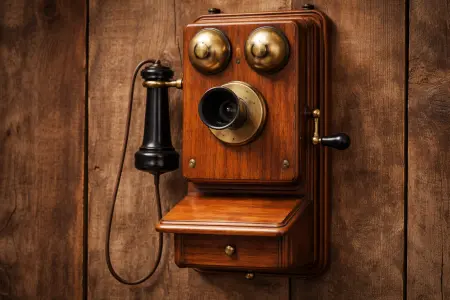
Early telephone designs relied on a core insight: speech is a pattern of vibrations. If a thin diaphragm vibrates with a voice, and that motion alters an electrical circuit in a continuously varying way, the circuit can carry a matching pattern. At the other end, a receiver can convert those electrical variations back into vibrations — recreating sound.
This meant the telephone was not just a better telegraph. It was a fundamentally different approach — one that treated electricity as a fluid carrier for changing, wave-like information rather than a simple on/off switch.
The First Telephone Call and a Famous Sentence
On March 10, 1876, Bell documented a historic moment in his notes: an intelligible message transmitted to his assistant, Thomas A. Watson, in another room. The words — “Mr. Watson — come here — I want to see you” — are famous partly because they are so ordinary. They were not a speech to a nation or a formal demonstration. They were a practical instruction, proving the device could carry meaning, not just noise.
The Telephone Patent War: Bell vs Gray — and the Problem of “First”
Few technologies arrive without conflict, and the telephone patent war became legendary. On February 14, 1876, filings connected to Bell and to inventor Elisha Gray reached the U.S. Patent Office on the same day — a coincidence that has fueled debate ever since. Bell ultimately received the key patent (No. 174,465) on March 7, 1876, and a long legal and public argument followed about priority, documentation, and influence.
For general readers, the most useful takeaway is this: the controversy reflects how innovation often works in the real world. Many people circle the same problem as materials improve and scientific knowledge spreads. What separates “an idea” from “the invention” is often a mix of engineering detail, timing, investment, and the ability to build a working system at scale.
| Figure | What They Contributed | Commonly Cited Dates | Why It Matters |
|---|---|---|---|
| Antonio Meucci | Early experiments associated with voice communication by wire | 1850s–1860s (historical accounts) | Shows the concept had earlier roots; later recognized in a U.S. House resolution |
| Johann Philipp Reis | Early “telephon” devices; sound transmission (often clearer for tones than speech) | 1857; demonstration dated to Oct. 1861 | Demonstrates an important precursor and terminology |
| Elisha Gray | Competing design ideas in the same period | Feb. 14, 1876 filings | Represents the “near-simultaneous invention” pattern; fuels Bell vs Gray debate |
| Alexander Graham Bell | Patent, documented early success, and commercialization | Mar. 7 and Mar. 10, 1876 | Connects invention to a practical, repeatable system — and a mass-market network |
From Device to Network: Exchanges, Operators, and the New Social Infrastructure
A telephone on its own is impressive. A telephone connected to one other telephone is useful. But a telephone connected to many others changes society. That step — from device to network — required a new kind of infrastructure: exchanges, switchboards, and skilled operators.
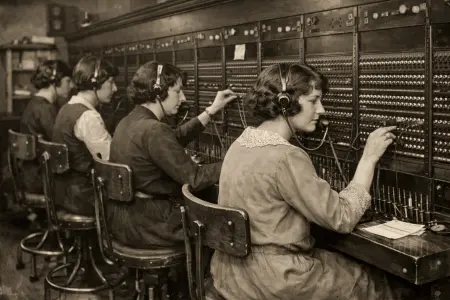
In 1878, the first commercial telephone exchange opened in New Haven, Connecticut. Instead of running individual wires between every pair of customers (a practical impossibility as cities grew), subscribers connected to a central office where calls could be routed. This exchange model accelerated adoption, and it also shaped telephone culture: the operator became a human interface between private lives and public technology.
The Age of the Switchboard Operator
Operators were not a footnote. They were the living glue of early networks. They managed traffic, handled emergencies, and enforced etiquette. In many places, telephone work became a major occupation for women — a rare case where a cutting-edge technology opened a large new category of paid labor.
Yet the operator era also exposed the tension at the heart of modern communication: convenience versus privacy. A line could carry a voice, but it could also carry gossip, misunderstandings, and the unsettling sensation that strangers might be listening. (For horror fans, this is where the telephone begins to feel uncanny — a disembodied voice arriving through a wire, turning a home into a stage for distant threats.)
Long-Distance and the Birth of Global Communication
Local calling proved the concept. Long-distance proved the revolution. Building long-distance service demanded stronger lines, better transmitters, and systems capable of maintaining clarity over vast distances. In 1885, the American Telephone and Telegraph Company (AT&T) was established to build and operate long-distance networks — a step that signaled the telephone’s transformation into a national system rather than a novelty.
By 1915, a highly publicized transcontinental call helped mark a new era of coast-to-coast service in the United States. Long-distance did more than shrink maps — it reshaped business culture. Decisions that once required travel could happen in minutes. Sales, logistics, customer service, and finance all changed as the voice became a management tool.
Why Switching Technology Changed Everything
As networks expanded, human-operated switching faced limits. Inventors developed automatic systems to route calls without an operator physically plugging cords. Almon B. Strowger is closely associated with early automatic exchange technology in the 1890s — a shift that paved the way for dial service and, eventually, the automated, software-driven switching behind modern telecommunications.
Across Oceans: The Telephone Goes Worldwide
Global communication demands more than long-distance poles and wires. It demands undersea engineering, signal amplification, and extreme reliability. A defining milestone arrived on September 25, 1956, when TAT-1 — the first transatlantic telephone cable system — entered service. For the first time, dependable voice calls could cross the Atlantic through a dedicated telephone cable network rather than relying on older arrangements or limited alternatives.
This leap accelerated international business, diplomacy, and journalism. The telephone did not merely connect individuals; it connected institutions. Over time, this global layer of connectivity became a backbone for later digital systems, from data networks to the internet.
Telephone Impact on Society: Business, Families, and Emergency Life
The telephone’s most dramatic influence may be social rather than technical. It changed the texture of daily life by making immediacy normal. A family could share news across a city in minutes. A doctor could be summoned quickly. A factory could coordinate supplies without waiting for letters.

Business Communication History — Rewritten by the Phone
Businesses reorganized around the assumption that people were reachable. Offices built telephone desks. Call centers became a new kind of workplace. Customer relationships shifted: a company could speak to a buyer directly, and a buyer could complain directly. Time became a sharper competitive weapon.
The Telephone and the Rise of Emergency Calling
The ability to call for help changed public safety. Over the 20th century, standardized emergency numbers emerged. The United Kingdom’s 999 service launched in London in 1937, often cited as the world’s first emergency call telephone service — a sign that telephony had become essential civic infrastructure, not just private convenience.
And if you love dark stories: the same feature that makes the telephone lifesaving — instant access — also makes it a perfect tool for suspense. The ring that interrupts dinner, the unknown voice, the wrong number, the call that arrives at exactly the worst moment — these became modern anxieties because the phone made intrusion effortless.
A Communication Revolution in a Longer Timeline
The telephone belongs to a chain of world-changing media revolutions. The printing press accelerated ideas by making texts replicable. The telegraph accelerated messages by making them electrical. The telephone made communication personal again — not via ink, but via voice.
In the modern era, that growing web of communication also reshaped politics and public life. If you’re exploring how new systems transform society under pressure, see our overview of the French Revolution, where information, fear, and mobilization collided on a national scale.
Fast Facts: The Telephone at a Glance
-
It grew out of telegraph research:
Many early breakthroughs came from attempts to improve telegraph systems and carry richer signals over a single wire.
-
March 7, 1876 matters:
Bell received U.S. patent No. 174,465 — a cornerstone in the legal history of telecommunications.
-
The first message was practical:
“Mr. Watson — come here” wasn’t meant to impress an audience; it proved intelligible voice transmission.
-
Networks beat gadgets:
The telephone became world-changing when exchanges made many-to-many calling possible.
-
Operators shaped early phone culture:
Before automated switching, operators connected calls, managed traffic, and became essential to public trust in the system.
-
Long-distance created new economies:
Long-distance calling compressed decision time for businesses, helped centralize management, and accelerated commerce.
-
Automation arrived early:
Automatic switching innovations in the 1890s reduced dependence on manual switchboards and enabled dialing.
-
Global voice service crossed oceans in 1956:
TAT-1 established a major new stage in worldwide telephone connectivity across the Atlantic.
-
Telephony shaped emergency response:
Standardized emergency calling systems emerged as phones became a core part of civic infrastructure.
-
It influenced culture — including horror:
The phone’s ability to bring unknown voices into private spaces made it a powerful symbol of modern anxiety and suspense.
The Invention of the Telephone — Frequently Asked Questions
Who invented the telephone — Alexander Graham Bell or someone else?
Bell is most widely credited because he secured the key 1876 patent and demonstrated a practical, intelligible system that could be commercialized. However, earlier experimenters (including Meucci and Reis) contributed important precursor work, and Elisha Gray represents a near-simultaneous rival path. The “invention” story depends on whether you emphasize concept, working device, or the scalable network.
What was the first telephone call?
A famous early successful message recorded by Bell on March 10, 1876, summoned his assistant: “Mr. Watson — come here — I want to see you.” It remains iconic because it documents clear, intelligible speech transmission.
How did early telephones transmit sound?
In simplified terms, a diaphragm vibrated with the speaker’s voice and changed an electrical current in a matching pattern. A receiver converted those electrical variations back into vibrations, reproducing sound.
Why were telephone exchanges such a big deal?
Exchanges made the system scalable. Instead of unique wires between every pair of customers, many subscribers connected to a central office, enabling city-wide (and eventually national) calling.
How did the telephone change the world?
It normalized instant, person-to-person communication across distance. That shift reshaped business operations, family life, emergency response, diplomacy, and culture — and it laid groundwork for later digital networks.
Conclusion: The Telephone’s Legacy in the Age of Smartphones
The telephone began as a daring idea: that a wire could carry the texture of a voice. It became a global system that restructured time, work, and relationships. The smartphone era can make the old telephone feel quaint, but modern communication still rests on the same foundational promise — that distance can be reduced to a signal.
If the printing press changed what people could share, and the telegraph changed how fast they could share it, the telephone changed something even more personal: it made the presence of another human voice available on demand. That is why its invention still matters. It did not just connect places. It connected lives.
Sources & References
- Coe, Lewis. The Telephone and Its Several Inventors: A History (McFarland, 1995).
- Brooks, John. Telephone: The First Hundred Years (Harper & Row, 1976).
- Library of Congress. “Invention of the Telephone” (Chronicling America research guide).
- Library of Congress. Bell papers overview including Bell’s March 10, 1876 notebook entry.
- National Park Service. “Site of the First Telephone Exchange” (New Haven, 1878).
- Congress.gov. H.Res.269 (107th Congress): recognizing Antonio Meucci’s life and work related to the invention of the telephone.
- Encyclopaedia Britannica. “Johann Philipp Reis” biography.
- AT&T. “History of AT&T Brands” (company history overview including 1885).
- Engineering and Technology History Wiki (ETHW). Milestone entry on TAT-1 (1956).