The French Revolution: Terror and the Making of Modern Europe
A documentary-style history of 1789–1799—from the Storming of the Bastille to the guillotine, the Reign of Terror, and the road to Napoleon.
Introduction
In the summer of 1789, Paris pulsed with rumors, hunger, and anger. Bread prices rose, royal authority wavered, and the streets filled with pamphlets that promised a new political world. Then came a day that would echo far beyond France: the Storming of the Bastille. It was not merely the fall of a prison—it was a public claim that power could change hands.
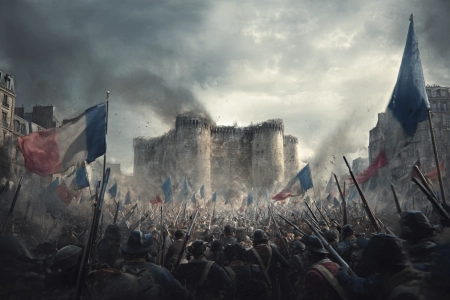
The French Revolution (1789–1799) began as a crisis of money and legitimacy, but it quickly expanded into a struggle over rights, sovereignty, faith, and violence. It produced soaring declarations and grim spectacles: the March on Versailles, civil war in the countryside, the guillotine in city squares, and the Reign of Terror under wartime emergency. By 1799, a young general—Napoleon Bonaparte—stood at the center of a new political order.
This article follows the Revolution’s major events, its most important personalities, and its deeper legacy—the ways it helped shape modern ideas of citizenship and the making of modern Europe, even as it revealed how fragile liberty can be when fear takes the reins.
French Revolution Timeline: A Snapshot of Turning Points
- 1789: Estates-General, Tennis Court Oath, Bastille, end of feudal privileges, rights declaration, March on Versailles
- 1791: Flight to Varennes and a collapsing constitutional monarchy
- 1792: War and revolution—monarchy overthrown, republic begins
- 1793–1794: Terror, Committee of Public Safety, civil war and mass arrests
- 1794–1795: Thermidorian Reaction and a turn away from radical rule
- 1795–1799: Directory instability, war, and political fatigue
- 1799: Brumaire coup and Napoleon’s rise to power
Causes of the French Revolution: Why 1789 Exploded
Financial collapse and political gridlock
By the late 1780s, the French state faced a severe fiscal crisis. War debts and a costly court strained the treasury, while attempts at reform ran into resistance from privileged groups. The monarchy could not easily raise revenue, and it could not easily change the rules without political support. When the crown summoned the Estates-General in 1789, it opened a door it could not later close.
Privilege, inequality, and anger
French society was still shaped by the logic of the old regime: legal privileges, unequal burdens, and a social order where the language of rights increasingly clashed with lived reality. Many commoners resented feudal dues and aristocratic advantage. In cities, workers and artisans lived close to hunger. When bread became scarce, anger became political.
Ideas in print—and a public that argued back
Enlightenment thinking did not cause the Revolution by itself, but it supplied a vocabulary: sovereignty, citizenship, and the idea that authority should be justified. The spread of political debate also depended on the long history of print culture. If you want the deeper backdrop, see The Printing Press and the Birth of the Modern World—because revolutions do not only happen in streets; they also happen on paper.
Side note: The phrase Liberty, Equality, Fraternity became closely associated with revolutionary ideals. It emerged during the Revolution as a popular slogan among others, even though it was not formally institutionalized as a state motto until later periods of French republican government.
1789: From Reform to Revolution
The Tennis Court Oath and the challenge to royal authority
In June 1789, representatives of the Third Estate claimed the right to speak for the nation. The Tennis Court Oath was a turning point: deputies pledged not to separate until France had a constitution. This was not a riot. It was a political rupture—an announcement that sovereignty could be argued, claimed, and rewritten.
The Storming of the Bastille
On 14 July 1789, Parisians stormed the Bastille. Its military value was limited, but its symbolic value was immense. The event quickly became a sign that crowds could act as political actors, not just as subjects. It also signaled that the Revolution would not be controlled only by speeches and votes.
Rights, fear, and the end of feudal privilege
In August, the National Assembly moved against feudal structures and issued the Declaration of the Rights of Man and of the Citizen. The document became one of the Revolution’s most enduring texts, proclaiming legal equality and rights rooted in citizenship. Yet the same summer also saw the Great Fear—panic and rumor in the countryside, where peasants attacked symbols of seigneurial power, fearing plots and hoarding.
The March on Versailles
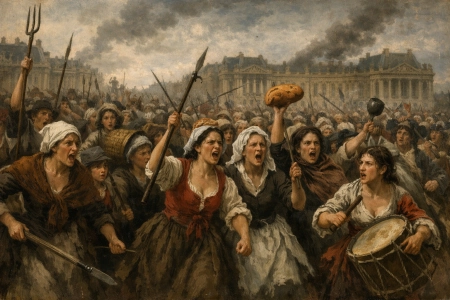
In October, anger over bread and distrust of the court converged in the March on Versailles. Crowds—including many market women—forced the royal family to relocate to Paris, where the king would be under the gaze of the capital. The Revolution was now closer to the palace than ever, and the monarchy’s freedom of action narrowed dramatically.
1790–1792: Constitutional Monarchy Collapses
Religion becomes political: the Civil Constitution of the Clergy
The Revolution’s relationship with religion became explosive. Policies that reorganized the Church and demanded oaths from clergy divided communities and fueled counterrevolutionary sentiment. For many believers, revolutionary change now looked like a threat to faith itself.
The Flight to Varennes
In June 1791, the royal family attempted to flee Paris in the Flight to Varennes. The failure of the escape hardened suspicion. A king who tried to leave could be seen as a king who rejected the Revolution. Trust, once cracked, now shattered.
War and radicalization
By 1792, France was at war with European powers that feared revolutionary contagion and questioned the legitimacy of the new order. War did not unite France; it intensified political struggle. Street politics, factional conflict, and fears of betrayal grew. In August 1792, an uprising in Paris effectively toppled the monarchy. In September, violence exploded in the September Massacres, as rumors of treason and invasion combined with panic and vengeance.
The Convention abolished the monarchy in September 1792, and the republic took shape in a nation at war. The Revolution had crossed a threshold: it now faced enemies abroad, civil conflict at home, and the question of how far it would go to survive.
Revolutionary France at a Glance: Phases, Governments, and Pressure Points
| Phase | Approx. Dates | Political Form | Defining Pressures |
|---|---|---|---|
| Early Revolution | 1789–1791 | Reform movement → constitutional monarchy | Bread crisis, legitimacy, rights debates, crowd politics |
| Republic and War | 1792–1793 | Republic (Convention) | Foreign invasion fears, factional struggle, internal revolts |
| Reign of Terror | 1793–1794 | Emergency wartime government (Committee-led) | Total war logic, mass arrests, revolutionary justice, civil war |
| Thermidor and Reaction | 1794–1795 | Retreat from radical rule | Political revenge, instability, economic hardship |
| Directory | 1795–1799 | Republic with limited stability | Corruption accusations, coups, war fatigue |
Reign of Terror: Robespierre, the Committee of Public Safety, and Revolutionary Violence
Why the Terror emerged
The Terror did not begin on day one. It grew from fear and emergency: foreign armies threatened France, revolts flared in parts of the countryside, and politicians accused one another of treason. In April 1793, the Convention created the Committee of Public Safety, which became a powerful wartime executive. Revolutionary government now argued that exceptional danger required exceptional measures.
Robespierre and the logic of virtue
Maximilien Robespierre became one of the era’s defining figures. To supporters, he was a guardian of the republic; to critics, a symbol of ideological rigidity. The Committee claimed it needed to purge enemies to save the Revolution. The language of virtue and patriotism turned into a political weapon: if the republic was the embodiment of liberty, then opponents could be framed as threats to the nation.
The guillotine and revolutionary justice
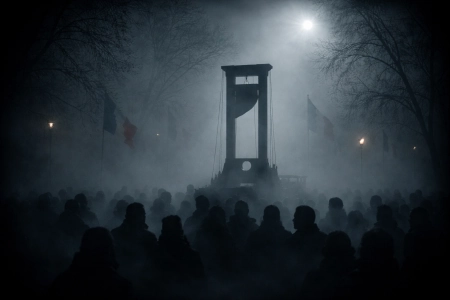
The guillotine was presented as a modern, efficient form of execution—equal in its blade, regardless of rank. In practice, it became the era’s stark emblem. Revolutionary courts and local authorities carried out punishments in the name of public safety. Tens of thousands were imprisoned as suspects; thousands were executed after legal proceedings, and many more died through civil war, prison conditions, and extrajudicial violence. The Terror reached its political climax in 1794, when fear of internal enemies merged with intense factional struggle in Paris.
Jacobins, Girondins, and the fracture of revolutionary politics
The Revolution’s internal conflict is often summarized through rival political identities. The Girondins were associated with a more moderate republicanism and suspicion of Parisian radicalism; the Jacobins were linked to a more centralized, militant defense of the Revolution in wartime. These labels can oversimplify, but the struggle between factions mattered. It shaped who held power, who was branded an enemy, and how the Revolution justified coercion.
Thermidorian Reaction and the Directory: The Revolution Exhausts Itself
Thermidorian Reaction: the fall of Robespierre
On 27 July 1794, the Revolution turned on itself. Robespierre and allies were overthrown in what became known as the Thermidorian Reaction. The shift did not erase revolutionary ideals, but it changed the tone of power. The most intense phase of the Terror ended, and a new struggle began over what kind of republic would follow.
The Directory and the problem of stability
The Directory (French Revolution) era attempted to stabilize France while avoiding a return to monarchy and avoiding another Terror. It inherited economic turmoil, political bitterness, and ongoing war. Elections, coups, and shifting alliances created a sense of constant improvisation. In practice, the Directory relied heavily on the army to maintain order—and that reliance opened the door to a general who understood power better than most politicians did.
Napoleon Bonaparte Rise to Power: Brumaire and the End of a Decade
In November 1799, Napoleon joined a coup that overthrew the Directory in the Coup of 18–19 Brumaire. The new regime—the Consulate—claimed it would preserve the Revolution while restoring order. Napoleon’s rise did not simply cancel the Revolution; it redirected it. Many revolutionary changes in administration and law would be strengthened, standardized, and exported across Europe by French power.
This is one reason the Revolution is often framed as the start of a modern European age: it created political models and conflicts that spread beyond France—through ideas, armies, and the shockwaves of war.
French Revolution Outcomes and Legacy: The Making of Modern Europe
The Revolution’s legacy is not a single outcome. It is a bundle of transformations—legal, political, and cultural—that changed Europe’s future arguments about power.
- Citizenship and rights: The Declaration of the Rights of Man and of the Citizen helped define modern political language around rights, equality before the law, and national sovereignty.
- The end of inherited privilege as a political default: Feudal and legal privileges were attacked, reshaping how people imagined social order.
- Modern mass politics: Newspapers, clubs, petitions, and street mobilization turned politics into a public arena, not just a royal one.
- State power and emergency rule: The Terror showed how a revolutionary state can expand coercion under existential threat—an enduring caution for modern politics.
- Nationalism and war: The French Revolutionary Wars spread new political ideas and intensified modern nationalism across Europe.
- Political symbolism: Revolutionary France generated powerful symbols and memories. Later European movements returned to 1789 as inspiration—or as a warning.
The Revolution also connects to longer global currents. France’s politics were entangled with the Atlantic world shaped since 1492—trade, empire, and colonial conflict. For that earlier turning point, see Christopher Columbus: The 1492 Voyage to the Americas. And for an earlier French story that later generations would turn into a national symbol, see Joan of Arc: Between History and Legend.
Fast Facts: The French Revolution
-
It began as a crisis of legitimacy and finance:
Debt, taxation disputes, and political paralysis pushed the monarchy into a confrontation it could not control.
-
The Bastille was symbolic:
The Storming of the Bastille mattered as a signal that the public could force political change, not because it held large numbers of prisoners.
-
The March on Versailles changed the geography of power:
By bringing the royal family to Paris, crowds tightened the capital’s control over the monarchy.
-
The Revolution accelerated under war:
Foreign threats and internal revolts helped justify emergency measures and sharpened factional conflict.
-
The Terror was tied to a wartime state:
The Committee of Public Safety became central as leaders argued that survival required harsh repression.
-
Thermidor ended one form of radical rule:
Robespierre’s fall did not end the Revolution, but it changed its direction and tone.
-
Napoleon’s rise closed the political phase:
The Brumaire coup replaced the Directory and opened the path toward imperial rule and a new European order.
-
The Revolution helped spread modern nationalism across Europe:
Through the French Revolutionary Wars and Napoleon’s campaigns, ideas of citizenship and the nation-state traveled widely, provoking both reform and resistance.
The French Revolution — Frequently Asked Questions
Was the French Revolution mainly about poverty and bread?
Bread crises mattered because hunger turns frustration into urgency. But the Revolution was also a political crisis: taxation, legitimacy, rights, and sovereignty were contested in a society where privilege still shaped law and status.
What did the Declaration of the Rights of Man and of the Citizen actually do?
It defined a new political ideal: rights and legitimacy grounded in citizens and the nation. Its principles inspired later constitutions and movements, even though practice often fell short, especially for women and colonial subjects.
Why did the Reign of Terror happen?
The Terror emerged from war, civil conflict, and fear of betrayal. Revolutionary leaders argued that extraordinary danger required extraordinary force, and political rivals increasingly framed one another as enemies of the republic.
Were the Jacobins and Girondins simply radicals vs. moderates?
Not entirely. The labels hide internal diversity. Still, the split reflects real conflicts over Paris’s influence, the direction of the republic, and how much coercion was acceptable to defend the Revolution.
Did Napoleon end the French Revolution?
Many historians see Brumaire (1799) as the effective end of the Revolution’s political experimentation. But Napoleon also preserved and expanded parts of the revolutionary settlement, especially administrative centralization and legal reform.
Why does the French Revolution still matter today?
It shaped modern debates about rights, citizenship, nationalism, and the limits of state power. It remains a reference point for both democratic hopes and warnings about political violence.
Sources & References
- Simon Schama, Citizens: A Chronicle of the French Revolution (Alfred A. Knopf, 1989).
- William Doyle, The Oxford History of the French Revolution (Oxford University Press, 2nd ed., 2002).
- Peter McPhee, The French Revolution, 1789–1799 (Oxford University Press, 2002; later editions available).
- Timothy Tackett, The Coming of the Terror in the French Revolution (Harvard University Press, 2015).
- Jules Michelet, History of the French Revolution (classic narrative; various editions).
- Encyclopaedia Britannica — entries on the Tennis Court Oath, Storming of the Bastille, Reign of Terror, Thermidorian Reaction, and Committee of Public Safety.
- Official institutional background on the motto Liberty, Equality, Fraternity — French Presidency / Élysée (historical overview).
- Lecture / Documentary suggestion: The Great Courses, The French Revolution (lecture series; instructor varies by edition).