Knights to Cannons: The Gunpowder Revolution
Explore how cannons and early firearms transformed warfare.
Introduction
In the late Middle Ages, the thunder of hooves began to fade beneath a new sound — the crack of guns and the roar of cannons. The gunpowder military revolution reshaped how wars were fought, how cities were defended, and even how rulers imagined their power. In the 15th century, heavy artillery and hand-held gunpowder weapons started to challenge the dominance of mailed knights and towering stone castles. From the fall of Constantinople to the slow decline of medieval fortresses, this transformation marked one of the most dramatic turning points in the history of warfare.
From Fireworks to Firepower: The History of Gunpowder
The story of the gunpowder military revolution begins long before the 15th-century battlefield. Gunpowder emerged from Chinese alchemical experimentation, where mixtures of sulfur, charcoal, and saltpeter were tested for effects that ranged from burning fiercely to exploding. By the 11th century, Chinese military texts recorded usable formulas and weapon concepts — a crucial step from dangerous curiosity to repeatable technology. Over the following centuries, gunpowder devices evolved from incendiaries and “fire-lances” into true projectile weapons, setting patterns that later innovators across Eurasia would adapt.
Gunpowder’s Journey from China to the Islamic World and Europe
Through trade routes and conquest, especially under the Mongol Empire, gunpowder technology spread across Eurasia. Islamic scholars and engineers experimented with recipes and devices, and by the 13th century CE, knowledge of gunpowder had reached the Mediterranean. European writers soon referenced strange new gunpowder weapons, including “thunder tubes” and “fire engines” that hurled stone or metal balls.
Early Artillery in Medieval Europe
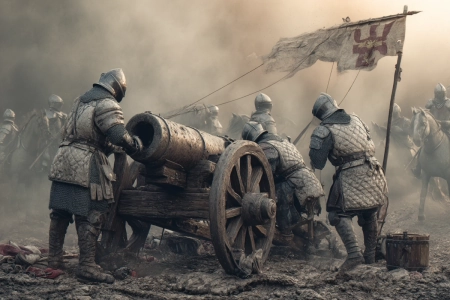
By the 1320s–1340s CE, European rulers were ordering cannons for their arsenals. These were often crude bombards: enormous barrels of wrought iron staves held together by hoops, or cast-bronze tubes reinforced with wood and iron bands. They fired stone balls using relatively low-pressure charges, making them slow and unpredictable. Still, even early cannons in medieval warfare offered something new — the ability to batter walls from a distance and terrorize defenders with deafening noise and flying debris.
What Sped Up — or Slowed — the Spread of Gunpowder
Gunpowder did not conquer the battlefield by “better weapons” alone. Its adoption depended on supply chains, skilled labor, and the ability of rulers to pay for experimentation at scale. In practice, the spread of guns and cannons was often uneven — fast in frontier wars and rich city-states, slower where resources, expertise, or political stability were limited.
- Accelerators: frequent warfare, wealthy states funding arsenals, access to saltpeter sources, and experienced founders who could cast reliable barrels.
- Slowdowns: scarce or impure ingredients, fragile metallurgy, bad roads (making heavy guns hard to move), and the high cost of powder, shot, and trained crews.
- Game-changer improvements: better powder processing (more consistent burn), standardized shot, and gun carriages that made artillery more mobile and tactical.
Early gunpowder artillery often appeared side by side with traditional medieval weapons. During the Hundred Years’ War, for example, English armies renowned for their longbowmen experimented with rudimentary cannons. This mixed technological landscape is also visible in the lives of figures like Joan of Arc, who led French forces in a world where armored knights, crossbows, and early firearms coincided on the same battlefield.
From Mounted Knights to Gunpowder Weapons: A Slow but Irreversible Shift
The phrase transition from knights to gunpowder can be misleading if it suggests an overnight change. Heavy cavalry remained important into the 16th century and beyond. Yet from the 14th to the 15th centuries, the foundations of traditional medieval warfare began to crack.
Plate Armor Meets Lead and Iron
For centuries, knights in plate armor had been the shock troops of Europe. Their armor evolved to counter new threats — thicker plates, rounded surfaces to deflect arrows and sword blows, and specialized helmets. Early handguns, such as hand-gonnes and arquebuses, were heavy, inaccurate, and slow to reload. At first, armorers responded by thickening breastplates and helmets to resist bullets.
Over time, however, gunpowder fire forced compromise. Armor could be made bullet-resistant, but only at the cost of greater weight and expense. For many lesser nobles and professional soldiers, the rising cost of high-quality armor could no longer be justified, especially when massed gunfire from infantry formations could still find a weak point.
Infantry on the Rise: Pikes, Guns, and Discipline
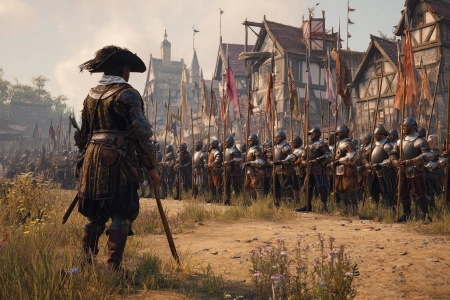
As firearms improved, infantry formations armed with pikes and guns began to rival, and eventually surpass, knightly charges. Pikemen could keep cavalry at bay, while soldiers with handguns or arquebuses delivered volleys of gunpowder weapons from behind their protection. The combined-arms tactics of late medieval and early modern armies would eventually lead to the famous pike-and-shot formations of the 16th century.
This growing importance of disciplined infantry echoed broader social changes. Rulers increasingly relied on paid professionals and long-service troops rather than temporary feudal levies. In this sense, the gunpowder military revolution was about more than weapons; it was about state power, taxation, and control — themes you can also see in episodes like the Black Death, which reshaped economies and societies before gunpowder took center stage.
Key Gunpowder Weapons in 15th Century Warfare
| Weapon | Approximate Use in Europe | Typical Role | Example / Note |
|---|---|---|---|
| Bombard | Late 14th–15th centuries CE | Heavy siege gun firing large stone balls at walls | Huge bombards used by the Ottomans at Constantinople (1453 CE) |
| Ribauldequin (“organ gun”) | Mid-14th–15th centuries CE | Multi-barrel gun for short-range volleys (anti-personnel) | Sometimes associated with early battlefield deployments like Crécy (symbolic, limited firepower) |
| Field Cannon | Mid–late 15th century CE | More mobile artillery supporting armies in the field | Smaller bronze guns on wheeled carriages; faster repositioning than bombards |
| Culverin (early long gun) | 15th–16th centuries CE | Longer barrel improves range and accuracy | Part of the shift from wall-smashers to versatile guns |
| Hand-gonne | 14th–15th centuries CE | Early hand-held firearm; ignition by match or touch-hole | Simple tube on a staff or stock; accuracy limited, fear factor high |
| Arquebus (matchlock) | Late 15th–16th centuries CE | More reliable infantry firearm with a firing mechanism | Foundation of firearm infantry units (pike-and-shot era) |
| Mortar | 15th–16th centuries CE | High-angle siege fire into cities and fortresses | Useful for plunging fire over walls and into crowded spaces |
When Did Gunpowder Reach European Battlefields?
Many readers look for a single “first battle with guns,” but the reality is messier. Early European firearms and small artillery pieces appear in records in the 1320s and 1330s, yet they were often few in number, unreliable, and used alongside traditional weapons. By the mid-14th century, guns were present in some major campaigns — sometimes more for shock and spectacle than decisive killing power.
What changed the military balance was not one dramatic debut, but accumulation: better powder, better barrels, better logistics, and the slow creation of professional gun crews. By the 15th century, that cumulative change made siege artillery truly formidable — and it pushed commanders toward new tactics and new defenses.
The Rise of Cannons in the 15th Century: Siege Warfare in the Age of Gunpowder
If handguns changed the battlefield slowly, heavy artillery changed it dramatically at city walls and castles. How gunpowder changed medieval warfare is perhaps most visible in the story of sieges — long, grinding contests between attackers and defenders that had defined medieval power politics.
The Fall of Castles to Gunpowder Artillery
Medieval castles relied on thick, high stone walls, towers, and gatehouses to deter attackers. Assaults with ladders or siege towers were dangerous; mining under walls was slow and risky; starvation sieges could take months. With the coming of heavy early artillery, besiegers could now stand at a distance and pound walls day after day.
The fall of castles to gunpowder did not happen everywhere at once. Many smaller fortifications remained militarily useful for centuries. But by the 15th century, the largest castles and city walls were increasingly vulnerable. Continuous bombardment could shatter masonry and open a breach, forcing defenders to surrender or risk a bloody assault.
The Fall of Constantinople: Cannons and the End of an Empire
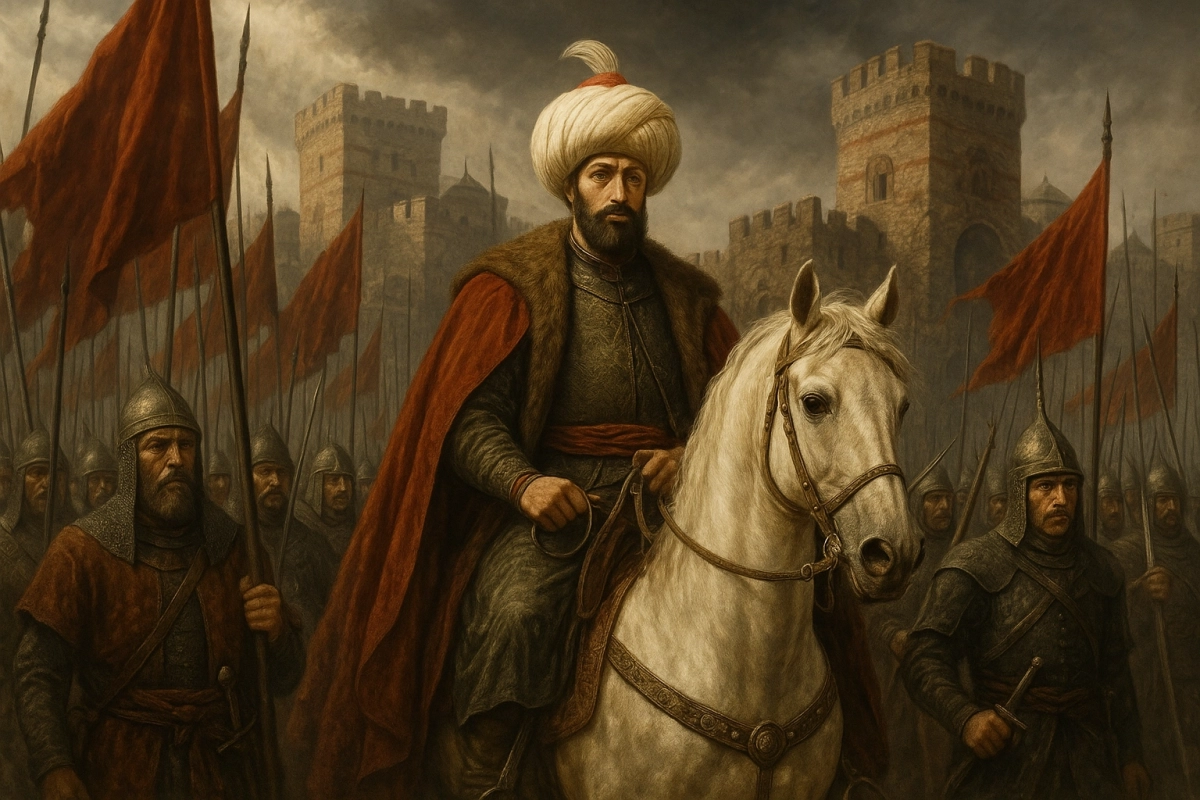
The most famous example of siege warfare in the age of gunpowder is the fall of Constantinople in 1453 CE. The Ottoman sultan Mehmed II, whose wider campaigns are explored in The Conqueror’s Journey: Mehmed II’s Rise Through War and Strategy, brought a powerful artillery train against the Byzantine capital’s legendary Theodosian Walls.
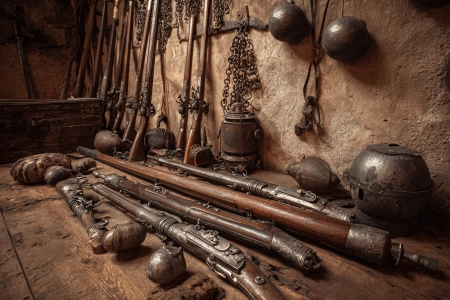
Massive bombards — some cast by a Hungarian engineer often named Urban in the sources — hurled huge stone balls at the walls for weeks. While the siege also relied on traditional methods such as mining, naval blockades, and assaults, the psychological and physical impact of these weapons was enormous. For many contemporaries, the fall of Constantinople cannons symbolized a new era in which even the mightiest fortifications could not guarantee safety.
“The sound of the thunder of the guns was such that all the city shook,” a later chronicler recalled. Even if embellished, such descriptions capture how the roar of artillery defined this new phase of warfare.
Other cities soon faced similar threats, from Italian city-states to fortified towns in Central and Eastern Europe. Rulers who once invested in great castles now poured money into artillery, gunpowder supplies, and new-style fortifications.
Redesigning Defense: Bastions, Star Forts, and the End of the Medieval Wall
As artillery grew more powerful and accurate, architects and engineers responded. High, thin walls were replaced by lower, thicker structures reinforced with earth to absorb cannon fire. Angled bastions allowed defenders to fire along the face of the wall, covering any breaches with crossfire.
This new style of fortification, often called the trace italienne or “Italian trace,” spread rapidly from the late 15th century onward. In many ways, these star-shaped forts represent the final stage of the gunpowder military revolution in fortifications: cities became armored in earth and stone specially designed to resist cannonballs, not battering rams or ladders.
These changes also transformed the look and feel of cities. Walls became sprawling systems of ditches, bastions, and outerworks, sometimes dwarfing the medieval cores they protected. Just as the printing press was reshaping the flow of information, gunpowder fortifications were reshaping the physical landscape of early modern Europe.
Noise, Smoke, and Fear: Life in the Age of Gunpowder Warfare
The gunpowder military revolution did not just change tactics and walls; it changed the sensory world of battle. Gunpowder fights were louder, smokier, and more chaotic than earlier clashes dominated by steel and muscle.
The Sound and Smell of Gunpowder
Cannons and handguns produced an almost constant barrage of noise — a mix of sharp cracks, deep booms, and the whistling of shot. Thick, acrid smoke hung over battlefields and siege lines, reducing visibility and choking soldiers. Contemporary accounts often describe battles as terrifying storms of fire and thunder, a striking contrast to the more focused clashes of earlier medieval warfare.
New Dangers for Artillery Crews and Civilians
Serving on a cannon crew was hazardous work. Misfires, barrel bursts, and flying splinters could kill or maim gunners. For civilians inside besieged cities, artillery bombardments brought new dangers: collapsing buildings, fires, and shrapnel. The psychological impact of relentless cannon fire could break morale even before a wall collapsed.
These experiences fed into broader patterns of fear and control that also appear in other “dark history” topics, such as the Inquisition or the reign of Elizabeth Báthory. Technology and terror often went hand in hand.
Fast Facts: From Knights to Cannons
-
Origins in China:
Gunpowder was first developed in China, probably by alchemists seeking an elixir of immortality, not a battlefield weapon.
-
From Fireworks to Weapons:
Early uses were fireworks and incendiary devices before true gunpowder weapons appeared in East Asia.
-
Gunpowder’s Westward Journey:
Knowledge of gunpowder moved through the Mongol Empire to the Islamic world and then medieval Europe.
-
Early European Cannons:
By the 14th century, European armies were using crude iron or cast-bronze bombards in siege warfare.
-
15th Century Warfare:
The 15th century saw a surge in cannons in medieval warfare, especially in sieges against castles and city walls.
-
Fall of Castles:
Thick but brittle high walls, once nearly impregnable, could now be shattered by sustained artillery fire.
-
New Fortresses:
Low, angled, earth-backed bastions were designed to withstand cannonballs, marking the fall of castles to gunpowder.
-
Changing Armies:
Armored knights remained important, but massed infantry with pikes and firearms grew increasingly decisive.
-
Ottoman Firepower:
The Ottomans and gunpowder weapons became a symbol of this new age, as at Constantinople in 1453 CE.
-
Lasting Legacy:
The gunpowder military revolution reshaped state power, military finance, and the very look of European cities.
Was It Really a “Revolution”? Debates and Long-Term Legacy
Historians still debate how “revolutionary” the gunpowder military revolution really was. Some argue for a relatively sudden transformation in the 15th and 16th centuries, when artillery and firearms forced rapid changes in fortifications, armies, and state finances. Others emphasize continuity, pointing out that knights, castles, and non-gunpowder weapons remained significant for generations.
Evolution, Not an On/Off Switch
In many regions, gunpowder simply became one more tool in the military toolbox. Commanders might deploy cannons alongside siege towers, or arquebusiers alongside armored cavalry. Warriors like Vlad the Impaler operated in this transitional world, where brutal traditional tactics and new technologies coexisted.
Over the long term, however, artillery and firearms proved decisive. They favored rulers who could afford large, permanent arsenals and professional armies. This pushed Europe toward more centralized states with stronger taxation and bureaucracy, a process that would continue well beyond the 15th century.
Gunpowder and Power: Why Kings Benefited More Than Local Lords
Gunpowder warfare rewarded rulers who could concentrate resources. Cannons, powder, shot, and specialists were expensive — and unlike a sword, they demanded constant resupply. As a result, central governments with taxation systems and bureaucracies gained an edge over smaller nobles who could not sustain artillery trains or permanent firearm units.
- Finance: artillery parks and fortifications required long-term funding, not one-time feudal service.
- Administration: states needed records, arsenals, and supply chains to keep guns firing.
- Political impact: fortified rebels and independent lords became easier to pressure when walls could be breached.
Beyond the Battlefield: Culture, Technology, and Memory
The cultural impact of gunpowder can be seen in art, literature, and even religion. Battles were now depicted with clouds of smoke and bursts of flame; rulers posed with cannons in their portraits, asserting their dominance through technology as much as lineage. Inventors and artists like Leonardo da Vinci sketched imaginative fortifications, multi-barrel guns, and new machines of war, blending scientific curiosity with the brutal realities of their age.
Today, the first rumbling of cannons in 15th century warfare can be seen as the opening act of a much longer story, one that leads through early modern conflicts to industrialized wars and, eventually, modern artillery and firearms. Understanding that story helps explain why the late Middle Ages and early Renaissance were such a pivotal crossroads in global history.
Gunpowder Military Revolution — Frequently Asked Questions
What do historians mean by the “gunpowder military revolution”?
The term describes the long process in which gunpowder weapons — especially cannons and early firearms — reshaped warfare, fortifications, and state power. From the late Middle Ages into the early modern period, gunpowder artillery and hand-held guns gradually undermined the dominance of armored knights and traditional castles, forcing rulers to invest in new armies, new fortresses, and new forms of taxation to pay for them.
Did gunpowder weapons immediately end the age of knights?
No — the transition from knights to gunpowder was gradual. Armored cavalry remained important into the 16th century, and many commanders still relied on traditional charges and close combat. Over time, however, massed infantry armed with pikes and firearms, supported by artillery, proved more decisive. As guns grew more powerful and accurate, it became harder to justify the cost and weight of full plate armor, and the knight’s battlefield role slowly declined.
What were common gunpowder weapons in the medieval era?
In late medieval Europe, common gunpowder weapons included heavy siege guns such as bombards, smaller field cannons, early hand-held firearms like hand-gonnes, and later matchlock arquebuses. Some armies also used multi-barrel weapons (often called “organ guns”), while sieges increasingly featured specialized artillery for breaching walls or firing into defended spaces.
What sped up, slowed, or stopped the spread of gunpowder weapons?
The biggest accelerators were constant warfare, reliable access to saltpeter, and states wealthy enough to fund casting, powder-making, and trained crews. Slowdowns included poor roads (making heavy guns hard to move), inconsistent powder, weak metallurgy, and the high cost of maintaining artillery and firearm units. In some regions, gunpowder spread unevenly because political fragmentation or resource limits made sustained investment difficult.
How did cannons change siege warfare in the 15th century?
In earlier medieval warfare, sieges could last for months while attackers relied on ladders, rams, mining, or starvation. With the rise of cannons in the 15th century, besiegers could stand at a distance and batter walls day after day. High, brittle stone defenses that had resisted trebuchets and battering rams were now vulnerable to sustained artillery fire, leading to faster capitulations and encouraging rulers to redesign their fortifications.
Were the Ottomans really ahead in using gunpowder weapons?
The Ottomans were among the most successful early adopters of gunpowder weapons. By the mid–15th century they fielded powerful artillery trains and integrated firearms into elite Janissary infantry units. The fall of Constantinople in 1453, where Ottoman bombards helped smash the city’s walls, became a famous example of siege warfare in the age of gunpowder. However, gunpowder technology was spreading widely across Eurasia, and European states quickly invested in their own heavy guns and early artillery.
How did gunpowder affect castles and fortified cities?
The spread of cannons in medieval warfare helped bring about the fall of traditional castles with tall, thin walls. To survive artillery bombardment, engineers developed lower, thicker ramparts backed with earth and angled bastions that could withstand and deflect cannon fire. This new style of fortress, often called the trace italienne or star fort, transformed the look of many European cities and became a core feature of early modern warfare.
How does the gunpowder military revolution connect to other 15th century changes?
The rise of gunpowder weapons unfolded alongside other major 15th century shifts: religious conflict, exploration, and new technologies like the printing press. Just as the printing press multiplied the reach of ideas, gunpowder multiplied the destructive power of states. Together, these changes helped drive Europe from a medieval world of local lords and walled towns toward larger kingdoms, global voyages, and increasingly centralized governments.
Sources & References
- Geoffrey Parker, The Military Revolution: Military Innovation and the Rise of the West, 1500–1800 (Cambridge University Press, 1996).
- Kelly DeVries, Medieval Military Technology (University of Toronto Press, 2012).
- Tonio Andrade, The Gunpowder Age: China, Military Innovation, and the Rise of the West in World History (Princeton University Press, 2016).
- Jack Kelly, Gunpowder: Alchemy, Bombards, and Pyrotechnics (Basic Books, 2004).
- Oxford (History of Science / collections essays): early European depictions and documentation of firearms in the 1320s.
- Encyclopaedia Britannica, “The Development of Artillery” (overview essays on artillery evolution and mounting systems).
- Bert S. Hall, Weapons and Warfare in Renaissance Europe: Gunpowder, Technology, and Tactics (Johns Hopkins University Press, 1997).
- Andrew Ayton and J. L. Price (eds.), Weapons and Warfare in the Renaissance World (various essays, 1990s–2000s).
- Articles on gunpowder, artillery, and medieval warfare from reputable online encyclopedias and museum collections (e.g., British Museum, Metropolitan Museum of Art).
- Documentary and lecture series such as The Great Courses: The Art of War in the Middle Ages and BBC historical programs on castles, cannons, and early modern warfare.
More Articles